
India’s AI SEO agency. We combine technical SEO, GEO, and LLM optimisation to rank your business on Google and get cited in ChatGPT, Gemini and Perplexity.
AI SEO Agency India: How We Rank Businesses on Google and in AI Search
Written by Syed Irfan Inayat, AI SEO Strategist, Colossus Digital Media | Last updated: April 2026
Two years ago, the only question a business needed to answer about search was: where do we rank on Google? That question still matters. But a second question now runs parallel to it: does our brand appear when someone asks ChatGPT, Perplexity, or Google’s AI Overview about what we do?
Most businesses have an answer to the first question and no visibility into the second. That gap is where AI SEO operates.
Colossus Digital Media is an AI SEO agency based in Srinagar, India. We work with businesses across India, the US, UK, and UAE to build search visibility across both channels — ranked positions in Google and cited presence in AI-generated answers.
What Is AI SEO?
AI SEO is the practice of optimising a website and its content to perform across both traditional search rankings and AI-powered answer engines. It combines the established disciplines of technical SEO, on-page optimisation, and authority building with newer practices specific to how large language models retrieve and cite content.
The term covers five distinct areas: Generative Engine Optimization (GEO), semantic SEO and topical authority, E-E-A-T signal building, technical SEO and Core Web Vitals, and schema markup. Each area has always been part of comprehensive SEO. What has changed is the weight each carries in an environment where AI systems now mediate a significant share of information delivery.
A business that ranks on page one of Google but has weak entity recognition, inconsistent structured data, and thin topical coverage will increasingly lose visibility to competitors who have addressed those areas — even if the competitor has fewer raw backlinks.
How AI SEO Differs from Traditional SEO
Traditional SEO targets ranked positions. The measurement is rank position and the click-through traffic that follows. The primary signals are backlinks, on-page keyword relevance, and technical health.
AI SEO keeps those signals and adds three layers on top:
- Entity recognition: Google’s Knowledge Graph and LLMs both need to confirm your brand, its category, its location, and its expertise before they will surface it in AI-generated responses. Entity clarity is built through consistent naming across directories, structured data, press mentions, and content depth.
- Passage-level optimisation: AI systems extract answers at the paragraph level, not the page level. Each section of your content needs to be independently coherent, capable of standing alone as a direct answer to the question implied by its heading.
- Citation authority: the sources AI engines cite most frequently are those with demonstrated topical authority: sites that cover a subject in full, from multiple angles, with named authors and verifiable credentials. A single well-written article does not establish citation authority. A content cluster does.
The practical difference: a traditional SEO campaign optimises ten pages for ten keywords. An AI SEO campaign builds a content architecture — pillar pages, cluster articles, author entities, structured data, and internal linking — that positions a domain as an authoritative source across an entire topic area.
The Five Components of AI SEO in 2026
Every AI SEO engagement at Colossus addresses these five areas. Each links to a dedicated guide with full implementation detail.
1. Generative Engine Optimization (GEO)
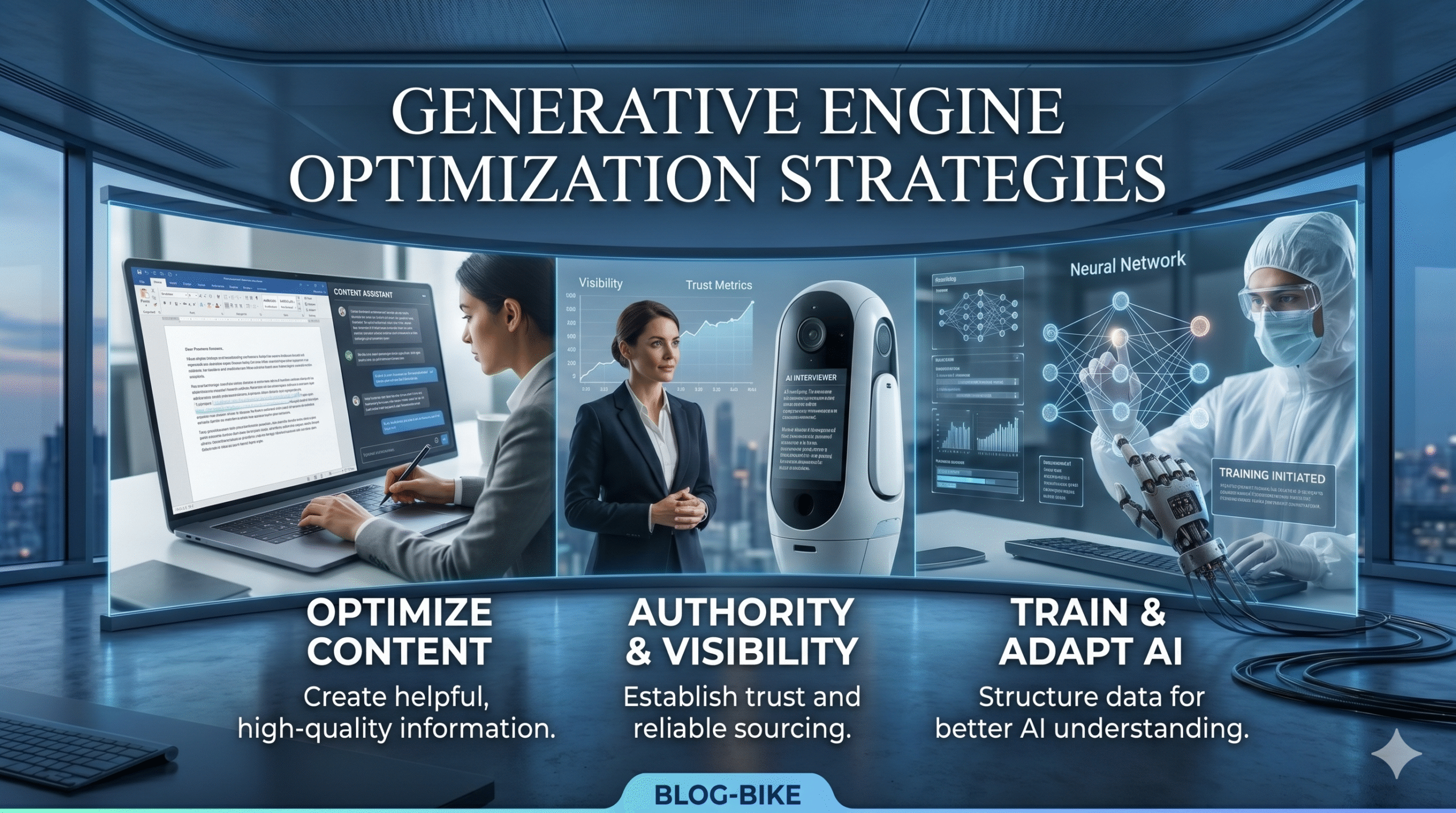
GEO is the practice of structuring content, brand signals, and authority so that AI search engines; ChatGPT, Perplexity, Google AI Overviews select your brand as a cited source when generating answers.
The core work involves building entity clarity, structuring content for direct-answer extraction, establishing topical authority through content clusters, implementing structured data that AI crawlers can process, and building the press and citation profile that LLMs weight as authority signals.
GEO is where traditional SEO and AI search optimisation diverge most sharply. A page can rank on Google without being cited in ChatGPT. The signals are related but not identical. GEO addresses the gap.
Know more about generative Engine optimisation
2. Semantic SEO and Topical Authority
Semantic SEO moves beyond keyword matching to topic coverage. Google’s natural language processing evaluates whether your content covers a subject with the depth and breadth it expects from an authoritative source — not just whether the page contains a target keyword.
Topical authority is established by covering every subtopic within a subject area that a credible source would address. For a digital marketing agency, that means not just a homepage service description but individual pages on each service, how-to guides, comparison articles, case studies, and FAQ content — all connected through a deliberate internal linking structure.
Thin topical coverage is one of the most common and most correctable reasons Indian agency websites fail to rank competitively against larger national players. It is not a resource problem — it is a content architecture problem.
Semantic SEO Framework 2026 — /the-definitive-guide-to-semantic-seo-framework-in-2025/
3. E-E-A-T Signal Building
E-E-A-T stands for Experience, Expertise, Authoritativeness, and Trustworthiness. Google’s quality rater guidelines use these four dimensions to evaluate whether content comes from a source qualified to make the claims it makes.
For agencies, E-E-A-T signals are built through: named authors with verifiable credentials and LinkedIn profiles linked from content, client case studies that name the client and include measurable results, press coverage and third-party mentions, accurate business information consistently applied across all platforms, and content that demonstrates hands-on knowledge rather than general description.
E-E-A-T is not a ranking factor in the direct sense — Google does not score pages on an E-E-A-T scale. It is the evaluative framework human quality raters use, and the patterns those raters identify are reflected in how the algorithm weights different signals. Pages that score well on E-E-A-T criteria rank better because they carry stronger trust and authority signals, not because they ticked a checklist.
E-E-A-T for Agencies: How to Build Google Trust Signals — /eeat-for-agencies/
4. Technical SEO and Core Web Vitals
Technical SEO ensures search engines can crawl, index, and understand your site without obstruction. In 2026, the technical layer includes several areas that were either absent or marginal five years ago.
Core Web Vitals: Google’s set of page experience metrics covering loading speed (Largest Contentful Paint), interactivity (Interaction to Next Paint), and visual stability (Cumulative Layout Shift) are now confirmed ranking signals. Sites with Poor Core Web Vitals scores are at a direct ranking disadvantage, particularly on mobile where local search traffic is highest.
AI crawler accessibility is a technical SEO concern that did not exist before 2023. GPTBot (OpenAI), Google-Extended, PerplexityBot, and ClaudeBot are the four AI crawlers most likely to index and cite your content. If your robots.txt file blocks them, your content cannot be included in AI-generated answers regardless of its quality. Most sites we audit have at least one AI crawler unintentionally blocked.
Core Web Vitals 2026: Technical SEO Checklist — /core-web-vitals-2026/
5. Schema Markup and Structured Data
Schema markup is code added to a page that tells search engines and AI systems what the content means, not just what it says. A page can describe a service without schema. With schema, it declares: this is a service, offered by this organisation, at this price range, in this location, with these reviews.
For AI SEO specifically, schema matters because LLMs and AI Overviews weight machine-readable signals when selecting and presenting information. FAQPage schema feeds directly into People Also Ask boxes and AI Overview extractions. Article schema with author Person markup establishes content provenance. Organization schema builds entity recognition.
The most common schema gap we find on Indian agency sites: LocalBusiness schema is present but missing geo coordinates, opening hours, or service area definitions. Each missing field is a missed signal.
Schema Markup Guide for Digital Marketing Agencies /schema-markup-guide/
How Google AI Overviews Work and How to Appear in Them
Google AI Overviews generate a synthesised answer at the top of search results for a growing share of queries. The source selection process pulls from pages that already rank well organically for the query — specifically pages in roughly the top 10 positions.
This means appearing in AI Overviews requires the same foundational work as ranking organically: keyword-matched content, strong technical health, and domain authority. What it adds on top is structural clarity. Google’s AI extraction algorithm selects passages from pages. it does not summarise pages as a whole. Pages that answer questions directly, use clear heading structures, and include definition-first paragraphs are selected more often than pages that answer questions indirectly.
Three specific practices increase AI Overview appearance rate:
- Match your H2 headings to the exact question format users ask — ‘What is [X]?’ rather than just ‘[X]’. The heading is a signal the content beneath it answers that question.
- Open each section with a one-to-two sentence direct answer, then elaborate. AI extraction picks the opening sentences of a section more often than mid-paragraph content.
- Include FAQPage schema on pages targeting question-based queries. Google’s AI Overview system has demonstrably higher representation from pages with FAQPage schema for the query topic.
AI SEO for Indian Businesses: What the Data Shows
The case for Indian businesses investing in AI SEO in 2026 is not speculative. It is visible in existing search data.
US and UK users are searching for Indian-based digital services, tourism, education, and manufacturing in AI engines and receiving AI-generated answers that name specific providers.
Indian businesses without GEO authority are absent from those answers. Their competitors in the US and UK, who charge three to five times more for the same services, appear instead.
For B2B service businesses agencies, SaaS providers, legal firms, accounting practices, consultancies — the international opportunity is the larger one. A Srinagar-based digital marketing agency that appears in Perplexity’s answer to ‘best AI SEO agency for US clients on a budget’ is competing at a global level without a global marketing budget.
The India domestic market has its own dynamic. Local and national searches in AI engines are still dominated by traditional SEO signals, GBP authority, local backlinks, on-page geographic relevance. AI SEO domestically means building those traditional foundations with the additional layer of entity clarity and topical authority that accelerates ranking in both Google and AI engines simultaneously.
Who AI SEO Is Right For
AI SEO is not a fit for every business at every stage. We work best with:
- B2B service businesses targeting India, US, UK, or UAE markets who want organic and AI search visibility as a primary acquisition channel
- Digital marketing agencies and SaaS companies who need to establish topical authority in competitive keyword categories where paid search costs are high
- Education institutions and ed-tech platforms with international student acquisition goals. AI search is now a primary research channel for international applicants
- E-commerce and D2C brands investing in long-term organic traffic rather than paid ad dependency
- Businesses that have tried generic SEO and seen limited results, typically because the work addressed keywords without addressing the content architecture and authority signals that AI-era search requires
We do not take on clients where the primary need is short-term, paid search management, one-off content production, or link schemes. AI SEO is a six-to-twelve month investment with compounding returns. The businesses that get the most from it are those building for a two-to-three year time horizon.
What Working with Colossus on AI SEO Looks Like
Every engagement starts with a full AI SEO audit: technical health, content architecture, entity signals, GSC data analysis, and competitor gap mapping. The audit produces a prioritised action list — not a 50-page report that sits in a folder.
Month one is fixes and foundations: technical issues resolved, meta rewrites implemented, schema added, internal linking corrected, and the highest-impact content either published or queued. Most clients see GSC impression and CTR improvements within the first 30 days from these changes alone.
Months two through six are authority building: content cluster publication, E-E-A-T signal development, link earning through press outreach and guest content, and GEO monitoring. By month three, most clients have their first AI citations for target queries. By month six, citation consistency is measurable.
We report through Google Search Console data and a weekly manual citation check querying target keywords in ChatGPT, Perplexity, and Google AI Overviews and recording whether the client appears. No vanity metrics. The numbers that matter are clicks, impressions, leads, and citation frequency.
Clients include IIM Jammu (education sector) and BioOrganic Dubai (international e-commerce). Case studies available on request.