Understanding the GEO Landscape
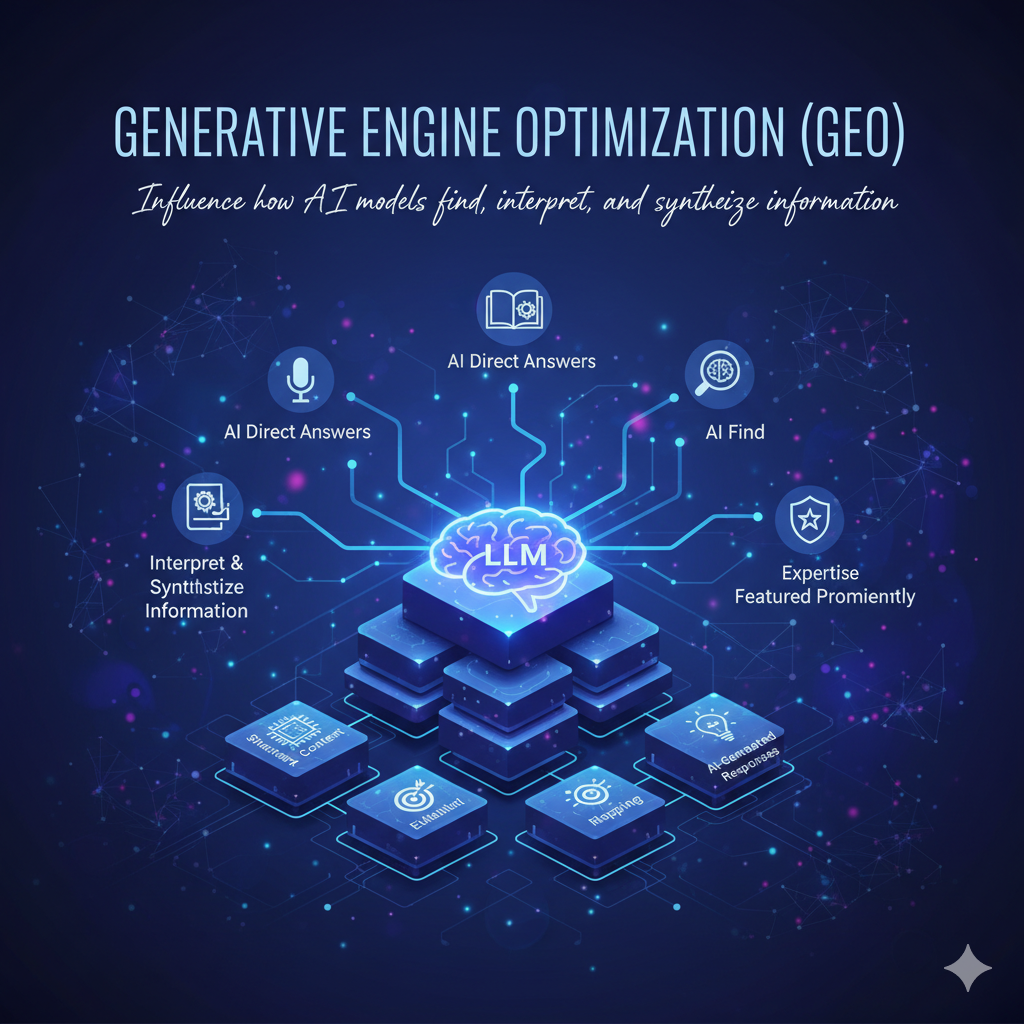
Generative Engine Optimization (GEO) is the practice of strategically structuring and enhancing our content to ensure its visibility and accurate representation within Large Language Model (LLM) workflows. In an era where users increasingly turn to AI for direct answers, the strategic importance of GEO for our content and marketing teams cannot be overstated. It represents a fundamental shift from traditional SEO, moving beyond keyword rankings to influencing how AI models find, interpret, and synthesize information.
The core purpose of GEO is to map the relevance of our content directly to the needs of these generative engines, ensuring our expertise is featured prominently in AI-generated responses. A successful GEO strategy is built upon several foundational components that work together to achieve this goal.
2.0 The Core Pillars of a GEO Strategy
The shift to Large Language Models (LLMs) and generative AI means that simply ranking high is no longer enough; content must be selected, trusted, and recalled by the AI itself. For colossusdigitalmedia.com, implementing a robust GEO strategy is essential to securing visibility in this new landscape.
Our implementation strategy is built upon the End-to-End LLM Optimization Cycles and focuses on three core pillars: Relevance Mapping, Content Enrichment, and Continuous Validation.
A successful GEO strategy is built on several key pillars that collectively ensure our content is findable, credible, and useful to generative AI models. Mastering these components is essential for gaining a competitive advantage in AI-driven search and information discovery environments. These pillars form the strategic foundation upon which all our tactical execution is built.
1. Intent Clustering: Our goal is to group related user queries and intentions to create comprehensive content that addresses a topic holistically, making it a more valuable resource for an LLM.
2. Trusted Source Signals: This component focuses on building and communicating our authority and credibility through signals that LLMs can easily recognize, such as clear authorship and verifiable facts.
3. Prompt Engineering: We will practice understanding and anticipating the types of prompts users will enter, allowing us to align our content with the specific questions AI is being asked to answer.
4. Snippet and Featured Entity Targeting: This involves identifying and optimizing for key people, concepts, or data points (entities) that are frequently featured in AI answers, as well as formatting content for optimal snippet extraction.
5. Ongoing Monitoring via LLM SERP Trackers: This pillar requires our continuous use of specialized tools to monitor how and where our content appears in AI-generated search engine results pages (SERPs).
These pillars represent our strategic “what.” The following 5-step cycle provides the operational “how.”
3.0 The 5-Step End-to-End GEO Implementation Cycle
Effective GEO is not a one-time project but a structured, repeatable process. This five-step cycle is our primary operational workflow for the content and marketing teams, enabling continuous improvement and adaptation to the rapidly evolving AI landscape.
3.1 Step 1: Research
The Research phase is the foundation of every GEO initiative. Our goal is to move beyond simple keywords to gain a deep understanding of user needs and the current behavior of generative engines within our specific domain. This initial analysis informs the entire optimization cycle.
• Investigate primary user intent: Analyze the core questions and problems users are trying to solve when they turn to an AI model.
• Analyze the common structures and formats of LLM-generated answers: Study existing AI responses in our domain to identify patterns, common sources, and preferred answer layouts (e.g., lists, summaries, tables).
3.2 Step 2: Map
In the Mapping phase, we use the insights from our research to create a strategic blueprint for our content. Our objective is to identify high-performing content elements that are most likely to be selected and featured by AI answer engines.
• Identify the best-performing user queries: Pinpoint the specific questions and prompts that generate the most detailed and relevant AI answers.
• Pinpoint the key entities frequently featured in AI answers: Determine the critical people, places, concepts, or brands that LLMs consistently reference.
• Determine the most effective formats for your content: Map out which content structures (e.g., lists, direct answers, comparative tables) are most successful for the queries we are targeting.
3.3 Step 3: Enrich
The Enrichment phase is where strategy becomes execution. This is where we build an undeniable competitive moat. By combining technical enhancements like structured schema and rich snippets with qualitative strengths like unique perspectives and trust signals, we create a content ecosystem that is both machine-readable and uniquely authoritative.
• Implement structured schema: Use schema markup to clearly label and define content elements (like authors, facts, and events), making them easier for AI to understand and process.
• Inject unique perspectives: Differentiate our content by including original insights, data, and expert analysis that cannot be found elsewhere.
• Integrate clear brand signals: Explicitly connect content to our brand to build authority and increase the likelihood of direct attribution in AI answers.
• Optimize for AI summaries: Structure content with clear, concise, and fact-based information upfront to make it easy for LLMs to generate accurate summaries.
• Develop rich snippets: Create and optimize content designed for featured snippet formats, which often serve as a primary source for AI-generated answers.
• Strengthen trust signals: Reinforce credibility through transparent author profiles and by explicitly mapping claims to verifiable, cited facts.
3.4 Step 4: Validate
The Validation phase is our internal quality assurance loop. Its purpose is to simulate how LLMs will interact with our content before publishing, allowing us to identify and fix gaps in retrievability and accuracy. This allows us to refine our approach based on direct AI feedback.
• Utilize retrieval augmented generation (RAG): Test whether AI models can successfully find and retrieve information from our content to answer relevant prompts.
• Employ AI feedback loops: Use AI tools to review and suggest improvements to our content, helping to align it more closely with machine-readable best practices.
• Implement AI verification signals: Ensure that the information presented is factually accurate and that citations are correctly attributed, confirming its reliability for AI sourcing.
3.5 Step 5: Track
The final phase, Tracking, is an ongoing process focused on measurement and continuous improvement. By consistently monitoring our content’s performance within LLM environments, we can adapt our strategy, refine our tactics, and demonstrate the return on our GEO investment.
• Use AI SERP measurement tools: Employ specialized software to monitor our visibility and ranking within AI-generated search results.
• Implement monitoring frameworks: Establish a system for watching for changes in LLM outputs and how our content is being represented over time.
• Track brand mentions: Monitor the frequency and context of our brand’s appearance within AI-generated answers to gauge influence and brand recall.
Consistent execution of this cycle is how we operationalize GEO. To prove its value, we must measure our success with a new set of LLM-native metrics.
4.0 Benchmarking and Measuring GEO Success
Success in Generative Engine Optimization is not theoretical; it must be quantified through specific performance indicators that track visibility and engagement within LLM environments. Unlike traditional web analytics, GEO requires a unique set of metrics designed to measure our influence on AI-driven answer engines.
• LLM SERP Visibility: This metric measures the frequency and prominence of our content and brand within AI-generated search engine results. It is the primary indicator of whether our GEO efforts are successfully capturing attention in the new search landscape.
• Answer Recall Rate: This measures how often an LLM correctly retrieves and uses information from our content when answering a relevant user query. A high recall rate indicates that our content is structured effectively and seen as a reliable source.
• AI Snippet CTR Optimization: This metric measures user engagement with our content within an AI-generated answer. Instead of a simple click-through, we will track interactions like expansions, information copies, or follow-up queries prompted by our featured snippet, quantifying its utility and engagement value.
• Trust Signal Enrichment: This is a measurable goal focused on verifying the implementation of our key authority indicators. Success is determined by the consistent presence of elements like author profiles and complete factual citation mapping across our content portfolio.
By focusing on these benchmarks, we can accurately gauge our performance and make data-driven decisions to refine our strategy.
5.0 Key Principles for Sustainable GEO Success
This guide outlines our comprehensive framework for navigating the new frontier of Generative Engine Optimization. As we integrate these practices into our daily workflows, it is crucial that we all remember the core principles that drive long-term, sustainable success in an AI-first world.
• Prioritize Trust and Enrichment: We must ground our GEO strategy in creating genuinely valuable and authoritative content. Adding unique perspectives and verifiable trust signals is paramount, as LLMs are being designed to prioritize high-quality, reliable information.
• Adopt a Cyclical Process: We must treat GEO as an ongoing cycle of research, implementation, validation, and measurement, not a “set it and forget it” task. A team-wide commitment to this iterative process is essential for adapting to the continuous evolution of AI models.
• Measure What Matters: Our success must be defined by metrics that directly reflect performance within generative AI ecosystems. Focusing on LLM-specific measurements like SERP visibility and answer recall rate will provide the clearest picture of our true impact.
Quick Wins:
Based on the GEO-Specific Guides and Benchmarking Frameworks, here are quick wins
1. AI Summary Optimization: Prioritize structuring key takeaways and definitions within content to be easily consumed for LLM summaries
2. Enrich Trust Signals: Immediately review and optimize author profiles and integrate factual citation mapping (a form of trust signal enrichment) into existing content to boost credibility
3. Deploy AI Verification Signals: Implement technical signals to explicitly indicate that your content has been verified or updated, which aids the LLM in the Validation phase
Final Thoughts
SEO isn’t a luxury—it’s a necessity. Starting SEO from day one isn’t just smart; it’s essential for building a brand that grows, competes, and thrives online. The sooner you begin optimizing, the sooner you’ll see long-term results.
Don’t wait for your business to grow before you start SEO. Let SEO be the reason your business grows.