Build a revenue-generating digital marketing strategy in 2026. Learn how to integrate SEO, PPC, content marketing & CRO into one scalable growth engine. Free audit inside.
Does Your Digital Marketing Spend Keep Growing But Your Revenue Doesn’t?
You’re investing in SEO. Running paid ads. Publishing content. And still watching your acquisition costs creep upward with no clear line between activity and revenue.
That’s not a budget problem. That’s a strategy problem.
Most businesses do not lack marketing tools. They lack structure. Without a unified framework connecting every channel to a measurable outcome, marketing budgets generate traffic — not profit.
This guide shows you exactly how to build a digital marketing strategy that integrates SEO, paid advertising, content, and conversion optimization into one compounding revenue engine. Whether you’re scaling an existing operation or starting from zero, the architecture here applies.
📈 Want results before you finish reading?
Get a Free Digital Marketing Strategy Audit — we’ll identify where you’re losing leads and revenue right now.
What Is a Digital Marketing Strategy?
A digital marketing strategy is a structured framework that defines how a business attracts qualified traffic, converts visitors into leads, nurtures prospects through a buying journey, and systematically increases customer lifetime value.
It aligns audience research, channel execution, funnel mapping, and performance analytics into one cohesive system. The critical distinction is this:
Digital marketing tactics generate activity. Digital marketing strategy generates predictable revenue.
If your business is investing in professional digital marketing agency services, the goal should be strategic integration — not isolated tactical execution. Channel-by-channel spending without a unifying framework is where most marketing budgets quietly disappear.
Why Digital Marketing Strategy Is More Critical in 2026 Than Ever Before
The competitive environment has shifted structurally. Four forces are simultaneously compressing ROI for businesses operating without a strategy:
Rising Customer Acquisition Costs
Google and Meta CPCs have increased consistently year over year. Without aligned conversion optimization and intelligent budget allocation, ad spend erodes profitability faster than it generates returns. Businesses using structured PPC management services must align ad campaigns directly with optimized landing pages and retargeting sequences — otherwise every click becomes an expense, not an investment.
Search Engines Now Reward Authority, Not Keywords
Search engines have evolved beyond keyword matching. They reward topical depth, content structure, and engagement signals. A scalable SEO strategy now requires technical optimization, content clustering, internal linking architecture, and precise search intent alignment working together. If your SEO investment lacks topical coverage, rankings become unstable and traffic becomes unpredictable. Strategic SEO services must focus on authority building, not isolated keyword targeting.
AI Content Saturation Has Changed the Baseline
AI tools enable rapid content production at scale. Every competitor now has access to volume. What differentiates visibility today is structured authority, contextual relevance, and funnel integration. Volume without structure does not build authority. It creates noise.
Multi-Touch Attribution Has Become Non-Negotiable
Modern buyers interact with multiple touch points before converting — organic search, paid retargeting, email automation, social proof, case studies. A digital marketing strategy that cannot track assisted conversions is operating blind. Understanding the entire customer journey is no longer optional; it is the foundation of accurate budget allocation.
The Four Pillars of a High-Performance Digital Marketing Strategy
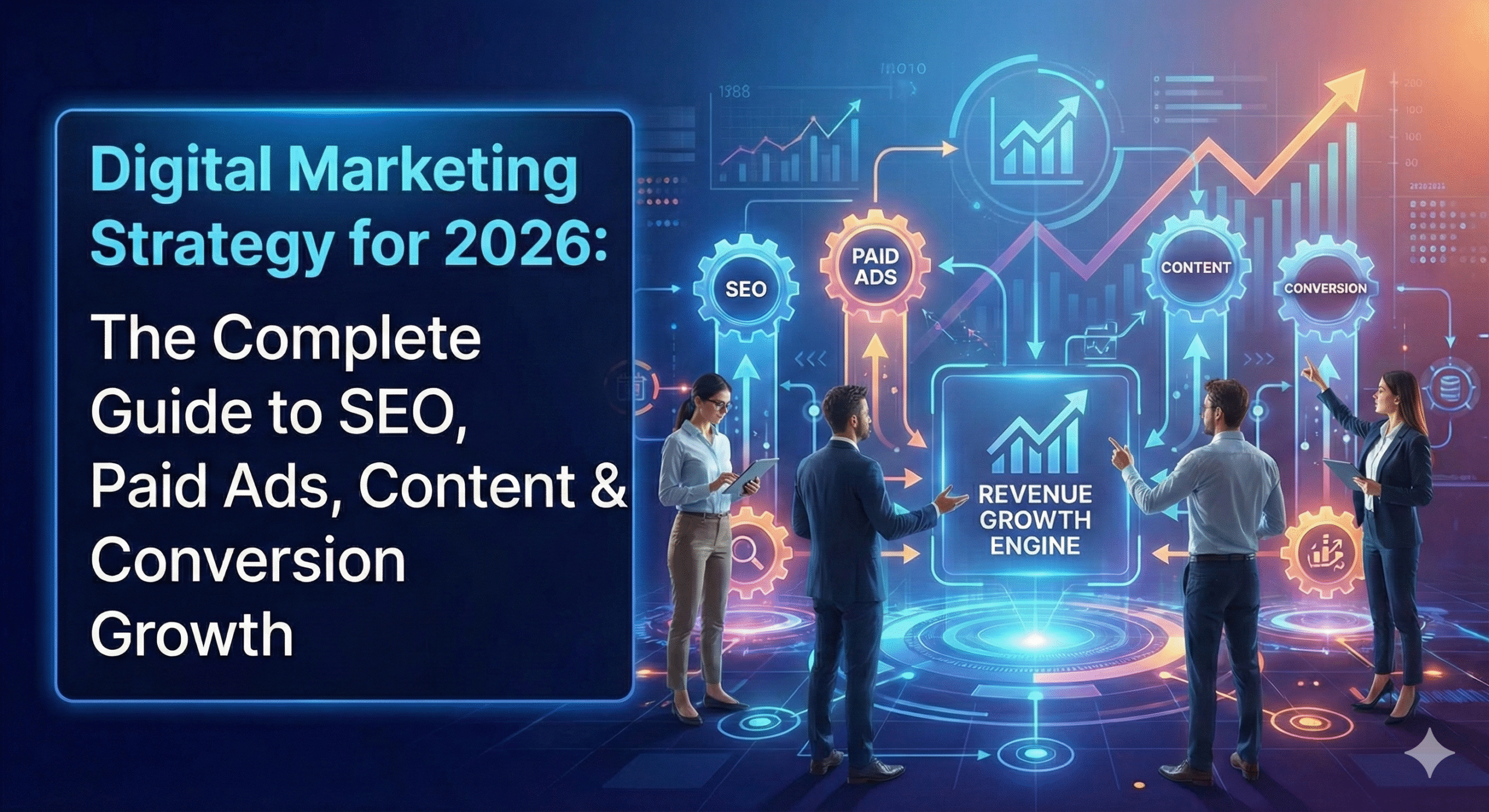
Every scalable digital marketing strategy integrates four core pillars. These pillars do not compete for budget or attention. They reinforce each other — and the compounding effect is where real growth lives.
Pillar 1: Search Engine Optimization (SEO)
SEO builds long-term organic visibility and compounding traffic growth. A structured SEO strategy includes technical SEO audits, keyword intent mapping, topic cluster development, on-page optimization, authority building, and internal linking systems.
Businesses investing in structured SEO services benefit from long-term traffic stability and consistently lower acquisition costs over time. SEO primarily supports the awareness and consideration stages of the funnel — but traffic alone is not enough. It must convert.
Pillar 2: Paid Advertising (PPC & Social Ads)
Paid advertising accelerates growth and validates messaging quickly. A high-performing paid strategy includes audience segmentation, offer testing, funnel alignment, retargeting frameworks, budget optimization, and full conversion tracking.
Well-structured PPC management allows businesses to test high-converting offers, scale profitable campaigns, and capture high-intent traffic immediately. Paid advertising generates speed. Strategy generates sustainability.
Pillar 3: Content Marketing
Content marketing builds authority, trust, and long-term brand positioning. Strategic content includes educational blog content, comparison guides, service landing pages, case studies, email sequences, and downloadable resources.
A structured content marketing strategy aligns every asset with search intent and funnel stage. Content supports SEO authority, paid retargeting, email nurturing, and conversion optimization simultaneously. Without strategic content mapping, traffic has no direction and leads have no journey.
Pillar 4: Conversion Rate Optimization (CRO)
CRO transforms existing traffic into revenue without increasing ad spend. It improves headline clarity, value proposition alignment, trust signals, CTA placement, landing page structure, and user experience. Even a small lift in conversion rate dramatically improves overall marketing ROI.
Businesses investing in structured conversion rate optimization services reduce wasted traffic and increase profitability from every channel simultaneously.
How These Four Pillars Become a Growth Engine
Disconnected marketing reduces ROI. Integrated marketing multiplies it.
Here is what integration looks like in practice: SEO drives qualified organic traffic. Retargeting ads re-engage users who didn’t convert on the first visit. Content builds trust and answers objections throughout the consideration stage. Optimized landing pages convert high-intent prospects into leads. Email automation increases lifetime value after the first conversion.
Each channel strengthens every other. This is the structural difference between tactics and strategy.
How to Build a Digital Marketing Strategy: Step-by-Step Framework
Step 1: Define Revenue Objectives
Set measurable financial targets before selecting any channel. Monthly revenue goals, lead volume targets, customer acquisition cost thresholds, and lifetime value benchmarks must be defined first. Marketing metrics must connect directly to revenue — not impressions, not clicks, not sessions.
Step 2: Identify Your Ideal Customer Profile
Define the industry, budget range, pain points, buying triggers, and decision-makers your business serves. Precise targeting improves both organic and paid performance. Broad targeting inflates spend and reduces conversion rates across every channel.
Step 3: Map the Customer Journey
Break down your funnel into stages: Awareness → Consideration → Decision → Retention. Then match channels accordingly. SEO supports awareness. Content supports consideration. PPC accelerates the decision stage. CRO drives conversion. Email increases retention and lifetime value. Every channel has a purpose within the journey, not outside it.
Step 4: Allocate Budget Strategically
Balance long-term authority building through SEO and content, immediate revenue generation through PPC, and conversion improvement through CRO testing. Diversification across these three areas reduces volatility and creates compounding returns over time.
Step 5: Implement Full-Funnel Analytics
Track conversion rate, customer acquisition cost, return on ad spend, assisted conversions, and revenue per channel. Without data integration across every touchpoint, optimization is guesswork. Attribution must be configured before spending scales, not after.
Budget Allocation Model for 2026
A common starting distribution for businesses building integrated strategies:
- 40% SEO & Content — builds compounding long-term authority and organic lead flow
- 40% PPC — generates immediate revenue while SEO compounds
- 20% CRO & Testing — improves profitability from every existing traffic source
Allocation depends on industry competitiveness, revenue goals, sales cycle length, and current authority level. Strategic guidance from an experienced digital marketing agency helps determine optimal distribution based on your specific competitive position.
Digital Marketing Funnel: Channel Mapping by Stage
Awareness Stage — Channels: SEO blog content, educational guides, organic social. Goal: Attract qualified traffic from search and discovery.
Consideration Stage — Channels: Comparison content, retargeting ads, lead magnets. Goal: Build trust and authority with prospects who already know the problem exists.
Decision Stage — Channels: High-converting landing pages, paid ads, case studies. Goal: Convert prospects into leads with clear offers and strong social proof.
Retention Stage — Channels: Email marketing, remarketing, upsell campaigns. Goal: Increase lifetime value and reduce churn through continued value delivery.
KPIs That Actually Drive Revenue
Vanity metrics measure activity. Revenue-focused KPIs measure business outcomes. Focus on:
- Customer Acquisition Cost (CAC)
- Lifetime Value (LTV) and LTV:CAC ratio
- Conversion Rate by channel and funnel stage
- Cost per Lead
- Return on Ad Spend (ROAS)
- Marketing Qualified Leads (MQLs)
If you are measuring impressions and sessions without connecting them to cost and revenue, your reporting is decorative, not strategic.
Common Digital Marketing Strategy Mistakes That Destroy ROI
Businesses consistently fail for a small set of predictable reasons: channel silos with no cross-channel integration, no conversion tracking, weak landing pages disconnected from ad messaging, poor search intent targeting, and complete absence of attribution data.
If your campaigns generate traffic but not revenue, your strategy lacks integration — not budget. More spend into a broken funnel produces more expensive failures, not more growth.
When to Hire a Digital Marketing Agency
Consider external expertise when revenue growth stalls despite increasing spend, when acquisition costs are rising without a clear explanation, when internal teams lack the technical depth for strategic integration, or when campaign tracking is fragmented across disconnected platforms.
An experienced agency aligns SEO, PPC, content, and CRO under one strategic framework — creating the cross-channel compounding effect that isolated internal teams rarely achieve. If you’re evaluating your options, explore our full-service digital marketing agency solutions to understand how integrated execution drives scalable growth.
The Future of Digital Marketing Strategy: What Wins in 2026 and Beyond
Winning strategies will prioritize AI-assisted optimization, predictive analytics, search intent clustering, topical authority, cross-channel integration, and conversion architecture. The businesses that pull ahead in the next three years will be those that treat digital growth as an engineered system — not a collection of independent experiments.
Volume is no longer the advantage. Structure is.
Frequently Asked Questions
What is a digital marketing strategy and why does it matter?
A digital marketing strategy is a structured framework that integrates SEO, paid advertising, content marketing, and conversion optimization to generate predictable revenue. It matters because disconnected tactics generate traffic without profit, while an integrated strategy compounds results across every channel.
How much should I budget for digital marketing in 2026?
A common starting model allocates 40% to SEO and content, 40% to PPC, and 20% to CRO and testing. The right allocation depends on your industry, revenue goals, sales cycle length, and current organic authority.
What is the difference between digital marketing tactics and strategy?
Tactics are individual actions — publishing a blog post, running an ad, sending an email. Strategy is the architecture that determines which tactics to use, in what order, for which audience, connected to which measurable revenue outcome.
How long does a digital marketing strategy take to show results?
Paid advertising can generate leads within days. SEO and content authority typically compound over 3 to 12 months. A fully integrated strategy showing cross-channel compounding results is typically visible within 6 months of proper implementation.
How do I know if my current digital marketing strategy is working?
If you cannot directly connect your marketing spend to revenue outcomes — if CAC is rising, conversion rates are flat, and you can’t attribute leads to specific channels — your strategy lacks integration. A structured audit will identify exactly where the breakdown is occurring.
When should I hire a digital marketing agency instead of keeping it in-house?
When revenue growth stalls, acquisition costs rise, internal teams lack strategic integration capabilities, or tracking is fragmented, external strategic expertise typically accelerates results faster than internal restructuring.
Ready to Scale With a Structured Digital Marketing Strategy?
Most businesses are not failing because of a lack of effort. They are failing because their SEO, paid ads, and content efforts are operating independently — each generating activity, none generating compounding growth.
A properly engineered digital marketing strategy lowers acquisition costs, increases lead quality, improves conversion rates, and scales revenue predictably. You can continue running disconnected tactics. Or you can implement a strategy built for compounding growth.
📈 Get a Free Digital Marketing Strategy Audit
Our team will analyze your SEO performance, review your PPC efficiency, identify conversion bottlenecks across your funnel, map your scalable growth opportunities, and provide clear, prioritized next steps — specific to your business and competitive position.
No generic templates. No recycled strategies. Only revenue-focused execution.
👉 Schedule your free consultation today
Let’s build a digital marketing strategy that turns your traffic into predictable, scalable revenue.